
Concordat Watch - Concordats by country -
Belarus
After the Iron Curain fell and Belarus attained independence in 1991, its authoritarian President Lukashenko immediately began trying to use the Belarusian Orthodox Church to shore up his rule. His government has signed five concordat-like “agreements” with this part of the Russian Orthodox Church. Almost half the population call themselves Belarusian Orthodox, but only 15% are Roman Catholic. However, the Belarusian President appears to believe that a concordat with the Vatican will also help him.
President Lukashenko “has steadily turned Belarus into something akin to a prison colony. The possibility of ending up in prison is a constant risk for millions, and a check on even their most mundane daily routines.” Those imprisoned for “crimes” such as standing up for human rights are placed where they will be terrorised by violent convicts some of whom work for the secret service in exchange for more lenient treatment. [1]
Human rights advocates acknowledge that “strong, outspoken resistance on a global level [is] necessary to prevent authoritarian regimes from silencing their domestic critics”. [2]
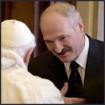
However, the Vatican, intent on getting a concordat with a brutal dictator, is keeping silent. Even the brutal tactics by President Lukashenko of Belarus in the December 2010 elections did not disturb his concordat negotiations with the Vatican — only the presumed objections of the Russian Orthodox Church, which now supports Putin's war machine. Lukashenko's reign of terror ensures that when a concordat finally comes, it will be ratified, but he will wish to avoid antagonising the Belarusian Orthodox Church that is part of the Russian one. No longer shunned by Western nations, he has less need of Vatican recognition. It is acknowledged by both sides that the concordat talks have "stalled". After Belarus was thrust into independence in 1991 its authoritarian president at first tried to use the Belarusian Orthodox Church to shore up his rule, as outlined in this 1996 article. However, the Belarusian national church is just a branch ("exarch") of the Orthodox Church of Russia, and therefore offered him little independence from the huge neighbour, so he next began looking to the Vatican to give help him find acceptance in the EU. The Belarusian Orthodox leader, Metropolitan Filaret of Minsk, hailed the 2003 concordat as "a blank cheque to develop co-operation programmes with all branches of power". (There are 14 so far.) The secret draft proposal of this contained anti-constitutional provisions such as immunity from prosecution for Orthodox clergy and media censorship powers for the Church. While these are not in the final version, there is concern that they may reappear in secret agreements. Since 1999 Belarus has been signing “co-operation agreements” with its Orthodox Church. A major “general accord” came in 2003. While lacking the international clout of concordats, these church-state pacts still confer many concordat privileges. In the old Soviet Union the Border Guard was part of the KGB, the secret police, and kept citizens from fleeing the country. In post-Communist Russia and Belarus the Border Guard has adopted the new state ideology — the Orthodox Church — but remains politicised. Here are excerpts from the Agreement between the Belarussian Orthodox Church and the Belarusian Border Guard.

1. Andrej Dynko, “Europe’s Last Dictatorship”, New York Times, 16 July 2012. http://www.nytimes.com/2012/07/17/opinion/belarus-europes-last-dictatorship.html
2. “Freedom House: Situation in Russia ‘Relentlessly Grim’”, Freedom House, 14 January 2011. http://www.theotherrussia.org/2011/01/14/freedom-house-situation-in-russia-relentlessly-grim/


