
Concordat Watch - Concordats by country -
Poland
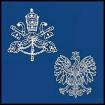
 This figure-ground papercut shows the Polish eagle alternating with the Holy Ghost (tucked between the delightfully rural goats supporting the shields). The Vatican hopes to use Poland's identification with Catholicism to influence the European Union. According to a confidential memo by US ambassador Francis Rooney, “the Holy See hopes that Poland will hold the line at the EU on 'life and family' issues that arise” and would “serve as a counterweight to western European secularism” once the country had integrated into the EU.
Poland has a pyramid of legally-sanctioned religious privilege. At the apex is the Catholic Church with its international concordat, then follow the 15 other religious groups (the latest being the Muslims) whose relationship with the state is governed only by specific national legislation. After those come 155 merely registered religious groups, and finally the rest.
In 1939, just three months after the German invasion of Poland, the Germanophile Pope Pius XII decided to put a German bishop in charge of a Polish diocese. His explanation that this was only a temporary apostolic administration did not satisfy the Polish Government in exile in London. It considered that this violated Article 9 of the 1925 concordat which stated that no part of Polish territory could be placed under the jurisdiction of a bishop whose see was located outside Poland. At the end of the war the Polish Communists made this official, and annulled the concordat on 12 September 1945. After this, relations with the Vatican had to be rebuilt stepwise from scratch:
♦ 1950 Modus vivendi (a foot in the door with the Communist regime, made with the Polish bishops)
♦ 1974 Protocol (to take up diplomatic relations with a regime the Vatican felt was there to stay)
♦ 1988 (unsigned) Convention (a draft concordat with the Communists which was quickly suppressed when the regime fell the following year, raising prospects of a better deal)
♦ 1991 Draft Concordat
♦ Papal signing authority for the following Concordat (7 July 1993)
♦ 1993 Concordat (ratified 1998) (gives the Vatican far more than the 1988 Draft Convention)
♦ 1998 Declaration by the Polish Government, an unsuccessful attempt to get some input in the form of a Supplementary Protocol to the Concordat, which the Vatican rejected
♦ 2007 Military chaplaincy agreement (a result of the concordat, but made with the Polish Bishops' Conference, not the Vatican)
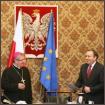
- Joint Commission for secret consultation between Catholic bishops and the state
Nip it in the bud. “Prior consultation” with clerics can prevent a governments from even proposing anything the Church opposes. This is why the negotiating team set up for the Vatican's 1950 deal with the communists still meets behind closed doors today to lobby the Polish government.
- Two decades of the concordat — “Observed by neither state nor church”
Accordiing to Dr Paweł Borecki, an expert in church law, the application of the Polish concordat has been selective. In the 20 years sinceit was signed, the Vatican has applied those provisions that favour it and ignored the ones that don't. The Church is given a free hand due to “the state's submissiveness”.

- The Church reshapes Polish society (2016)
Three Poles describe increased Church influence and restrictions on women since the end of Communism. “After 1989 women found that a democratically elected government gave them the right to vote in fair elections, but took away the right to decide about their own bodies.”
- Getting a concordat by hook or by crook*
It took ten years of planning, three papal visits and numerous legislative tricks, but in 1998 the Vatican finally managed to get the Polish concordat ratified. After that, a Declaration was attached to Poland's Accession Treaty to protect the concordat from EU human rights legislation.
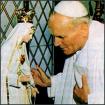
- Catholicism as Poland's national religion
In 1717 Clement XI had his nuncio crown an icon of the Virgin as Poland's Queen. The Virgin was also made responsible for the military protection of Poland, with the official title of Hetmanka, Commander-in-chief. John Paul II continued the tradition of militant marianism when in 1981 he enlisted a statue of the Virgin to help combat communism. The Virgin had this role in Argentina, as well.
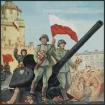
- Secret dealings with “Satan”: How the Polish modus vivendi came about
The 1950 Modus vivendi with the Soviet satellite of Poland was the first agreement between the Vatican and a Communist state. Never published in the official gazette, this pragmatic agreement was meant to grant secret concessions which set no precedent. To conduct these negotiations a Joint Commission of government and bishops was set up. This conducts secret meetings even today.
- Vatican version of the concordat negotiations
In two short accounts Bishop Alojzy Orszulik and Fr. Professor Wojciech Góralski present the negotiations as the Vatican would have them seen — as if the concordat originated in Warsaw, not Rome. Only passing mention is made of two key Vatican diplomats, the Cardinals Cesaroli and Silvestrini.
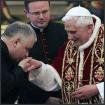
- The Church dominates the state
Legal expert, Dr. Pawel Borecki, discusses frankly Vatican manoeuvres to get the Polish concordat through before the country's new constitution. This meant that Poland's whole legal framework had to conform to the concordat and this contributed to the "further clericalisation of public life". Included at the end is a remarkably deferential note to the Pope from a future Polish Prime Minister.

- Complaint to the EU about Catholic Church privileges in Poland (2007)
This Complaint to the European Union shows how Polish laws favour the Church at the taxpayers' expense: in the way the laws are framed, in the way they're applied and in the way they're skilfully evaded. The chances of success of this complaint to the Barroso Commission may be slim, but it does contains solidly sourced information which is hard to find elsewhere in English.
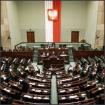
- Chaplain leads parliamentary rainmaking
Poland's parliamentary and presidential chapels are state-funded and have their own Catholic chaplain. They offer religious services on topics of current political interest and afford clerics privileged access to the lawmakers. And in the summer of 2006 the parliamentary chapel was the scene of what was greeted with mirth as a rainmaking ceremnony.
- The Polish Bishops' rules for leaving the Church
The Polish Bishops claim to want to “standardise the interpretation of the [Vatican] guidelines” when they erected these special barriers for Poles to leave the Universal Church, many of which would not likely be tolerated elsewhere. Most are nowhere to be found in the 2006 Vatican note to the bishops telling them in general terms to keep control of the process and not let it be handled by the state.
- .
Finances
How did the Catholic Church became the biggest landowner in democratic Poland? For a good summary, see the news article, Poland’s Property Commission on Trial for Deals that Handed Millions to Catholic Church (2013)
- Poland gives land and money to Church while a quarter of its children go hungry (2008)
The Polish Government can afford to subsidise Church influence in every corner of society, from salaries for the chaplains in the civil service, to holiday pay for the monks and nuns teaching religion in state schools. Yet it is unable to provide free school lunches for Polish children, a quarter of whom are malnourished. This is an itemised list of state subventions to the Church for 2008. The numbers will change from year to year, but the categories are likely to remain the same.
- The Property Commission (1989-2011) — Church land grab secured by the concordat
Poland's concordat removes Church land claims from parliamentary control. For two decades the Property Commission, which compensated the Catholic Church with land and money, accepted the Church valuation of the land it wanted. Yet the often drastic undervaluation could not be challenged in any Polish court. In 2004 the European Court of Human Rights ruled that this let the Polish Property Commission violate the right to a fair trial.
- Double compensation for Church land claims
In 1950 the Communists set up a “Church Fund” to compensate the Polish Church. But after accepting this, the Church demanded more, and not only compensation for land still in Poland, also for land now in Lithuania, Belarus and the Ukraine, as well as for land formerly owned by the Catholic Church in Germany. By 2004 the Church had lost 87,000 hectares and got “back” 94,000. Finally in 2011 Poland ended this by closing down the Property Commission which for 20 years had been effectively set its own prices for land returned to the Church.
- .
Education
How the Polish bishops' 1999 evanglisation plan for schools and universities is being implemented step by step.

- Creeping evangelisation in state schools
Although unwanted by most parents, Catholic Religious Education (catechism) has been inserted stepwise into Polish state schools. In June 2010 the European Court of Human Rights ruled that this violated religious freedom. Two translated newspaper articles report on what's happening in Polish state schools.

- Timeline: How catechism got into Polish state schools (1990-2010)
Bit by bit over twenty years, the Church has moved far beyond the education clause in the current concordat which guarantees catechism in state schools only where it is requested. Now, in practice, catechism is often compulsory, as it was officially in the 1925 concordat.* To see what this list means in terms of the pupils and their futures, see “Creeping evangelisation in state schools”.

- �Stork, bring me a bundle�: Sex education in Poland (2009)
The Polish government decided in 2009 that compulsory sex education is unconstitutional. A report released the same year reveals what actually goes on in these ― now optional ― classes. Youngsters have been taught that homosexuals should be quarantined and cured, that contraception is an invention of Satan, and that condoms can lead to impotence.
- .
Concordat texts
- Polish Modus vivendi (1950) : Text
This was the first agreement between the Vatican and a Communist state. Never published in the official gazette, this pragmatic arrangement was meant to grant secret concessions on both sides in order to set no precedent. In return for supporting the Polish Communists (and preventing disturbances that could bring in Russian tanks), the state permitted the Church to retain more influence than in other Communist countries.
- Protocol (1974)
After the pope devised a face-saving way to open up talks with the Communists in 1961, there followed agreements in 1964 with Hungary, in 1966 with Yugoslavia and in 1974 this one with Poland. The same process is still being carried out today, with, for instance, the Vietnam-Vatican Joint Working Group, established on 16-17 February 2009 with a view to establishing diplomatic relations.
- Convention (1988): Text of the suppressed agreement
This was a “convention”, not a concordat, as it was signed by a Polish Archbishop and not by a representative of the Vatican. This ill-timed agreement was “annulled” ― ostensibly due to socio-political changes, to which the Church “wished” to adapt ― when the Church realised that it could soon get a far better terms after the collapse of Communism. With this, the Convention was regarded as void.
- Draft Concordat of 1991: Text and commentary
This draft concordat remained unpublished until it was leaked more than ten years later. Shortly after it was drawn up it was replaced by a new draft which was also kept secret ― even from the members of parliament who were to vote on it ― until it had already been signed.


