



 Vatican Foreign Ministers: Agostino Casaroli (1967-1990)
This legendary cardinal-diplomat served under five Popes. Appointed roving ambassador in Eastern Europe in 1961, he took part in the 1975 Helsinki Conference, urging that religious freedom be monitored in Communist countries. The Soviets retaliated by putting a “bug” inside his statue of the Virgin.
Casaroli served as the Vatican's Foreign Minister under two different titles. From 1967 he headed the Congregation for Extraordinary Ecclesiastical Affairs, and then from 1979 until his retirement in 1990 he led the Secretariat of State, the new name for the Vatican's Foreign Ministry.
For decades Casaroli masterminded Vatican diplomacy and the Soviets naturally tried to keep track of him. They bugged the armoire in his dining room and also managed to bribe his nephew whose wife was the Cardinal's housekeeper. The couple presented Casaroli with a ceramic statute of the Virgin Mary which contained a tiny but powerful transmitter that was monitored from outside the building by the couples’ handler from the Soviet embassy in Rome. [1]
After the election of the "Polish pope" Casaroli is claimed to have worked secretly with the US to use religious zeal to weaken the USSR. (See Cold-war religious fronts against the Soviets in Poland and Afghanistan?)
♦ Excerpt from Peter Hebblethwaite, "From Ostpolitik to Europapolitik"
♦ Short biography of Casaroli (translated from a Polish encyclopaedia)
The first excerpt, by Peter Hebblethwaite a former Jesuit and top Vaticanologist, outlines the Vatican's three diplomatic stages with a country in achieving the "full existence" of the Church there, (which, of course, implies obtaining concordat privileges). Casaroli pursued a "small-steps diplomacy" and his memoirs are titled The Martyrdom of Patience. This excerpt also shows how the charismatic John Paul II toughened up the diplomacy of the cautious Casaroli in the pursuit of the Vatican's Ostpolitik, (its dealings with the Communist countries of Eastern Europe).
...The Vatican's approach to Eastern Europe changed rapidly under the Polish Pope's direction. The small-steps diplomacy continued. But it was now run from a position of strength, in close conjunction with local bishops' conferences. The Pope stopped making concessions and gave up appointing collaborator-bishops. [2]
Perhaps Casaroli's most enduring legacy in more than sixty years of serving the Church was his contribution to the Helsinki Conference, a landmark in the process of détente.
The Vatican's greatest success was probably the religious rights clause it inserted in the Helsinki Agreement on European Security and Cooperation of 1975. It gave all the Central-East European signatories an international treaty to which they could appeal. [...] Surprisingly the Communist-bloc countries accepted the clauses on human rights and religious freedom, perhaps thinking that they would remain a dead letter. Instead, oppressed groups appealed to the Helsinki principles, and at intervals the Helsinki conference reassembled in European capitals to review the situation of religion and conscience. These were international forums in which the Christians of Central and Eastern Europe could make their voices heard. This was an important factor in the erosion of the Soviet system. It was a triumph of pure diplomacy. [3]
Excerpt from
Peter Hebblethwaite, "From Ostpolitik to Europapolitik",
European Journal, N. 11, 1/1991, pp. 62-64.
http://www.europeanjournal.org/issues/old/n11/n11p59-73.pdf
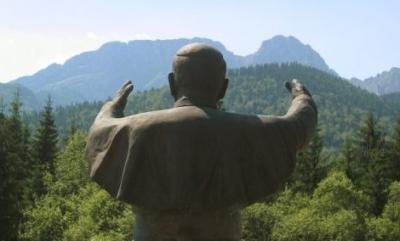
Statue of John Paul II blessing Poland
...What was Casaroli doing in his diplomatic dealings with Eastern Europe? He had the following theory. He distinguished between three stages in the life of the Church in Communist countries: the esse [Latin: existence], the bene esse [good existence], and the plene esse [full existence]. First of all, the esse was the mere existence of the church: its survival — however obstructed — underground if need be, but still there, still in business, administering the sacraments. Once survival was assured, the battle moved on to the right to appoint bishops freely, to organise seminaries for priestly training, to hold catechism classes. Secure legally entrenched rights on such questions and the bene esse of the church would be established. This is what Casaroli pressed for at the CSCE conference at Helsinki in 1975 where the Vatican was represented at an international meeting for the first time since the Congress of Vienna. He presented religious freedom as an aspect of general human rights. [...]
But the presupposition of all this was that the plene esse, the fullness of the rights of the church, lay far ahead [...]; for seen from 1975, the regimes of "real socialism" had not conceded much and still had a very permanent feel. [...]
In 1978, there came the surprise of a Polish Pope. Many observers said a Polish Pope was impossible. [...] The election of a Polish Pope made an immediate and dramatic difference to the Vatican's Ostpolitik.
Then there was the first visit to Poland in June 1979. [...] The Polish government certainly had the physical means to keep the Pope out: but in practice it could not stop him from going home, much less censor him once he was there. Quite a bit has been made of the way his first visit gave Poles the self-confidence which led to the formation of Solidarity the following year.
John Paul acted as the tribune of the people. He articulated their aspirations. Reviving the theme of the millenium celebrations of 1966, he claimed that the church embodied the soul and the culture of the Polish nation in a way that the party could never aspire to.
At Gniezno Pope John Paul II proclaimed the "spiritual unity" of Europe. [...] Why Gniezno? It was there that the first Polish King, Miesko, was baptised in 966: so the baptism of the king and the birth of the nation coincided. At Gniezno in June 1979, he proclaimed the spiritual unity of Europe, and said that it was to proclaim this unity that Providence had chosen a Slav Pope. It is difficult for mere politicians to argue with divine Providence.
This short biography from a Polish encyclopaedia focusses on Casaroli's role as roving ambassador in Eastern Europe from 1961 until 1979 when he was rewarded with the number two job at the Vatican and became Secretary of State.
Translated from
"Casaroli Agostino", Encyklopedia Wiem.
http://portalwiedzy.onet.pl/33135,,,,casaroli_agostino,haslo.html
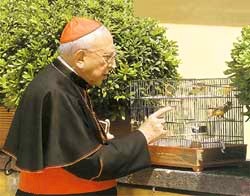 Agostino Casaroli (1914-1998), cardinal, Vatican diplomat. He studied Canon Law [in the seminary in Bedonia, at left], then graduated from the Pontifical Ecclesiastical Academy, training personnel for the Secretariat of State, where he began work in 1940.
He designed the Vatican's Ostpolitik, initiating the policy of establishing contacts with the communist countries of Central and Eastern Europe. In 1964 he signed a partial agreement with Hungary, which normalised the situation of the Catholic Church in that country, and was the first formal agreement between the Vatican and a communist country. In 1965 he negotiated a similar agreement with the government of Czechoslovakia, and in 1966, with Yugoslavia.
In the '60s he began to travel to Poland, leading the negotiations mostly on the legal status Catholic Church on the "Recovered Lands" [the territory taken over from Germany when Poland got shoved westward after WWII. These bore fruit in 1971 when the Catholic and other churches got legal title to the lands that they had been administering on the Western and Northern Lands].
In 1967 Pope Paul VI appointed Casaroli archbishop and Secretary of the Council for the Public Affairs of the Church (Foreign Minister), [forerunner of the post-1988 Section for Relations with States]. In 1971 he became the first representative of the Vatican posted to the Kremlin in Moscow. 1974 signed an agreement for the establishment of working relations with Poland. He continued diplomatic travel to communist countries — 1974 to Cuba, 1975 to the German Democratic Republic, 1976 to Bulgaria. 1979 was accompanied by Pope John Paul II on his trip to Poland. [Later he conducted negotiations with the former Soviet Union, leading to the official visit by Mikhail Gorbachev to the Vatican in 1989.]
In [1979] he was appointed cardinal and Secretary of State of the Vatican City State — a function he held until 1990, when passed into retirement, while Deputy Dean in the College of Cardinals. For almost 50 years he was involved in the care of minors and criminals in one of the suburbs of Rome.
Notes
1. Edward Pentin, "Spying on the Pope", Zenit, 2013-10-31. http://www.zenit.org/en/articles/spying-on-the-pope
2. Jonathan Luxmoore, "The cardinal and the Communists", The Tablet, 2000-09-02. http://archive.thetablet.co.uk/article/2nd-september-2000/4/the-cardinal-and-the-communists
3. Desmond O'Grady, "Casaroli's Long March", The Tablet, 2000-09-02. http://archive.thetablet.co.uk/article/9th-september-2000/8/casarolis-long-march
Official biography (in Italian): http://www.cardinalcasaroli.org/cardinale/biografia.asp
Obituaries
Alessandra Stanley, "Agostino Cardinal Casaroli, 83, Dies; Led Vatican to Detente", New York Times, 10 June 1998. http://www.nytimes.com/1998/06/10/world/agostino-cardinal-casaroli-83-dies-led-vatican-to-detente.html
Felix Corley, "Obituary: Cardinal Agostino Casaroli", The Independent, 10 June 1998. http://www.independent.co.uk/arts-entertainment/obituary-cardinal-agostino-casaroli-1163946.html
Jan de Weydenthal, "Vatican's 'Ostpolitik' architect dies", RFE/RL [Radio Free Europe/Radio Liberty] Newsline, Vol. 2, No. 111 Part II, 11 June 1998. http://www.friends-partners.org/friends/news/omri/1998/06/980611II.html

